Why Nighttime Grinding Is So Hard to Detect
During the day, you are aware of what your jaw is doing. You feel tension. You catch yourself clenching. You can stop.
At night, that feedback loop is gone. The majority of sleep bruxism takes place early in the sleep cycle, during stages 1 and 2 of non-REM sleep. You are not deeply unconscious, but you are not conscious enough to notice or respond to what your jaw is doing. By the time you wake up, the grinding episode ended hours ago. What remains are the consequences — the soreness, the fatigue, the dull ache spreading from your jaw toward your temples.
8 Signs You Are Grinding Your Teeth at Night
1. Your Jaw Hurts in the Morning
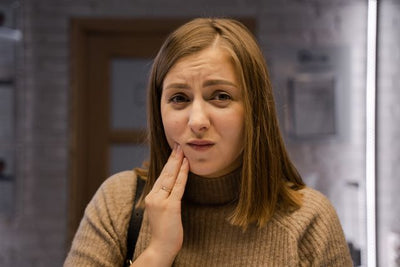
This is the most common sign and the one people most often dismiss or blame on sleeping in an odd position. Waking up with jaw pain or soreness, especially along the muscle in front of your ear or at the jaw hinge, is a telltale sign of nighttime teeth grinding.
The masseter muscle — the thick jaw muscle you can feel when you clench your teeth — does most of the work during a grinding episode. After hours of activity during the night, it wakes up exhausted and sore, the same way your legs feel after a long run. If your jaw consistently aches in the first hour after you wake up and eases as the day goes on, bruxism is a likely explanation.
2. You Wake Up With Headaches
Morning headaches that feel like tension headaches are a recognized sign of nighttime clenching and grinding. They tend to concentrate around the temples, behind the eyes, or across the forehead. Many people who grind their teeth spend years treating these headaches with over-the-counter pain relief without ever identifying the actual source.
The mechanism is straightforward. The same muscles that grind your teeth attach to the sides of your skull. Hours of sustained contraction creates tension that radiates into a headache by morning. If you regularly wake up with a headache that was not there when you went to sleep, and no other obvious cause explains it, teeth grinding deserves serious consideration.
3. Your Teeth Are Becoming Flatter or More Sensitive
Healthy teeth have a natural shape with visible cusps. When grinding has been occurring for months or years, those cusps gradually flatten. Bruxism can cause tooth erosion and loose or cracked teeth over time. Alongside this wear, many people notice increased sensitivity — particularly to cold drinks or sweet foods. This happens because grinding wears through the enamel, exposing the softer dentine underneath.
4. Someone Else Hears It
This is often the most reliable early warning signal. A partner, roommate, or family member hears a grinding or squeaking sound during the night. If a sleeping partner is telling you that you grind your teeth at night, take it seriously. Not all grinding is audible — clenching produces no sound at all and can cause as much damage as grinding. But when audible grinding is reported, it is a strong confirmation.
5. Your Face or Ear Feels Sore Without Explanation
Headaches, earaches, or facial pain upon waking, especially where the jaw muscle is active, are associated with nighttime teeth grinding. Earache with no infection present is a particularly common complaint. The jaw joint sits directly in front of the ear canal, and inflammation in that joint can feel exactly like an ear problem.
6. You Notice Marks on the Inside of Your Cheeks or Tongue
Biting your tongue or the inside of your cheek frequently is your body signaling something is happening during sleep. If you regularly wake up with a tender spot on your tongue or a raised line of tissue along the inside of your cheek, your teeth are coming together with enough force and frequency to cause soft tissue contact.
7. Your Sleep Feels Unrestorative
People with sleep bruxism often wake up feeling tired or unrested, even without remembering waking during the night. Grinding episodes can interrupt the normal sleep cycle, pulling you briefly toward lighter sleep stages. Persistent fatigue that does not improve with a consistent sleep schedule is worth investigating from multiple angles, and bruxism is one of the less obvious contributors that often gets missed.
8. Your Dentist Mentions Wear
During regular dental check-ups, dentists look for signs of bruxism such as flattened tips of the teeth. They can also spot micro-fractures, unusual wear patterns, and changes to existing restorations. If your dentist has mentioned tooth wear without a clear cause, or has asked whether you clench or grind, take that question seriously.
What Happens If You Ignore It
Constant grinding and clenching wear down tooth enamel, the protective outer layer that shields teeth from decay and sensitivity. Over time, this wear can lead to cracks, fractures, and even tooth loss. Beyond the teeth, teeth grinding can increase the risk of problems with the temporomandibular joint — the joint that connects the lower jaw to the skull. TMJ disorder can cause chronic jaw pain, difficulty opening and closing the mouth, and a clicking or popping sensation that becomes a daily irritation.
What You Can Do About It
If several of the signs above apply to you, the most practical first step is protecting your teeth while you investigate further. Most people who grind their teeth can ease symptoms with a custom mouth guard. A night guard creates a protective barrier between your upper and lower teeth, absorbing the grinding force and preventing enamel wear.
At DentalNightGuard.com, guards start from $99 and are made from the same dental-grade materials used in dental offices. The impression kit ships to your door, you take your impressions at home in around 15 minutes, and your custom guard is delivered within 5 to 7 business days. No appointment. No waiting room. No $400 to $800 bill.
Order your custom night guard from $99 at DentalNightGuard.com